World Cup 2026 draw sets stage for heavyweight clashes, classic rivalries
The 2026 World Cup draw in Washington set heavyweight clashes, including England-Croatia and Brazil-Scotland, outlined host paths for USA, Canada and Mexico, and highlighted star players who could define the tournament.
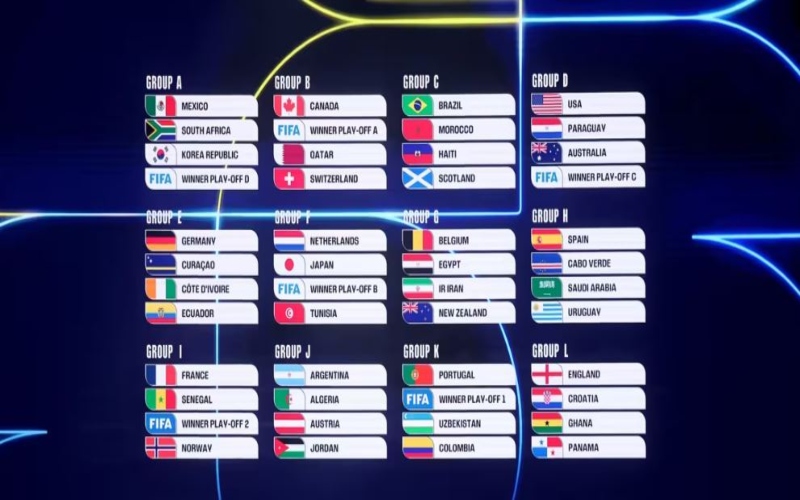
The 2026 FIFA World Cup took shape on Friday in Washington as the draw produced heavyweight rematches, intriguing reunions, and pathways lined with both peril and possibility for the 48 nations heading to the United States, Canada and Mexico in the next 187 days.
The ceremony, already packed with anticipation, veered into drama as US President Donald Trump received FIFA’s inaugural “Peace Prize”, a decision met with raised eyebrows inside the auditorium. But once the balls were drawn, the true spectacle began.
England were handed a familiar foe in Croatia, Scotland landed a daunting date with Brazil, and host-continent sides USA, Canada and Mexico all learned the contours of their quests on home soil.
England headline Group L, where Gareth Southgate’s men will open their campaign with a rematch of the 2018 semi-final against Croatia.
The encounter instantly became one of the tournament’s most anticipated fixtures, pitting England’s attacking riches against Luka Modric, somehow still timeless at 40 and coming off an impressive resurgence with AC Milan.
With Harry Kane leading the English line after yet another prolific year in Germany, Group L promises fireworks from the first kick.
Scotland’s fate unfolded with its own sense of déjà vu and dread. Placed in Group C, the Scots will face Brazil, Morocco and Haiti in what early analysts regard as one of the tournament’s more unforgiving clusters.
Their opener against Haiti, to be staged either in New Jersey or Massachusetts, will carry enormous weight for both sides - a chance to gain a foothold before duelling with the Atlas Lions and the five-time champions.
If France, Norway and Senegal’s collision course in Group I has been labelled the “Group of Death”, it is with good reason. France arrives with Kylian Mbappé in irresistible scoring form for Real Madrid, already surpassing 25 goals this season and showing little sign of slowing.
Norway counters with Erling Haaland, a goal-scoring machine whose 55 tally in just 48 international appearances has shattered every arithmetic expectation. Add the wily threat of Senegal, and the group becomes a powder keg.
With 48 nations in this expanded edition, the stars to watch stretch beyond the traditional giants. Every country enters its best hope, its talisman, its spark and the tournament promises to showcase both established icons and ascending wonderkids.
In Group A, Mexico will lean heavily on veteran striker Raúl Jiménez, whose 121 caps and invaluable experience must steady a side still searching for form. South Korea, on the other hand, count on their premier attraction, Son Heung-Min, the former Tottenham great, who is now thriving at LAFC with 12 goals and three assists in just 13 matches.
Group B features two of the world’s most influential left-footed leaders. Canada counts on Alphonso Davies, one of football’s fastest men and a constant outlet on the flank, expected to return from injury in time to anchor their transition game. Switzerland will once again revolve around Granit Xhaka, now a stalwart at Sunderland and closing in on a remarkable 150 caps.
Group C’s marquee name is Vinícius Júnior, the Real Madrid winger whose explosiveness must now translate into Brazilian heroics. Morocco counters with Achraf Hakimi, whose surging runs from right-back have become a defining feature of PSG’s Champions League-winning edge.
The co-hosted Group D welcomes the USA, led by Christian Pulisic, who, at 27, is already a veteran of American football’s modern renaissance. Australia will rely on midfield fulcrum Jackson Irvine, whose journeys through the Scottish Premiership and the Bundesliga have shaped him into the side’s stabilising presence.
Group E promises technical mastery from Bayern Munich’s Jamal Musiala, one of the brightest talents in world football, and Ecuador’s industrious Moisés Caicedo, now central to Chelsea’s rhythm.
Virgil van Dijk anchors the Netherlands in Group F, still among the game’s premier defenders, while Japan’s Takefusa Kubo, fresh from his best La Liga season, brings invention and fearless incision down the wings.
Belgium’s veteran identity shifts to the gloves of Thibaut Courtois in Group G, their last global superstar in peak condition. Iran’s hopes rest with striker Mehdi Taremi, whose 56 international goals underline his enduring potency.
Spain’s future is embodied in the precocious brilliance of 18-year-old Lamine Yamal, already a 100-match Barcelona phenomenon and Euro 2024 champion. Uruguay buoys in Group H with Federico Valverde, whose boundless engine and Real Madrid pedigree now define La Celeste’s heartbeat.
Argentina’s Group J storyline is simple yet seismic: will Lionel Messi grace one final World Cup? If not, Julián Álvarez stands ready to shoulder the mantle, with David Alaba, Austria’s seasoned and versatile leader, commanding the other side of the group.
Meanwhile, Portugal’s creative reins in Group K lie firmly in the hands of Vitinha, the PSG midfielder who orchestrated last season’s Champions League triumph. Colombia return with their eternal World Cup talisman, James Rodríguez, still capable of conjuring brilliance at age 34.
With the draw complete, national teams can now plot, plan and dream. For some, the road will begin with daunting giants; for others, opportunity glimmers through the gaps.
But as anticipation swells across continents, one thing is certain: World Cup 2026 is poised to deliver a month of spectacle, storylines and stars who could redefine football’s future.
Top Stories Today